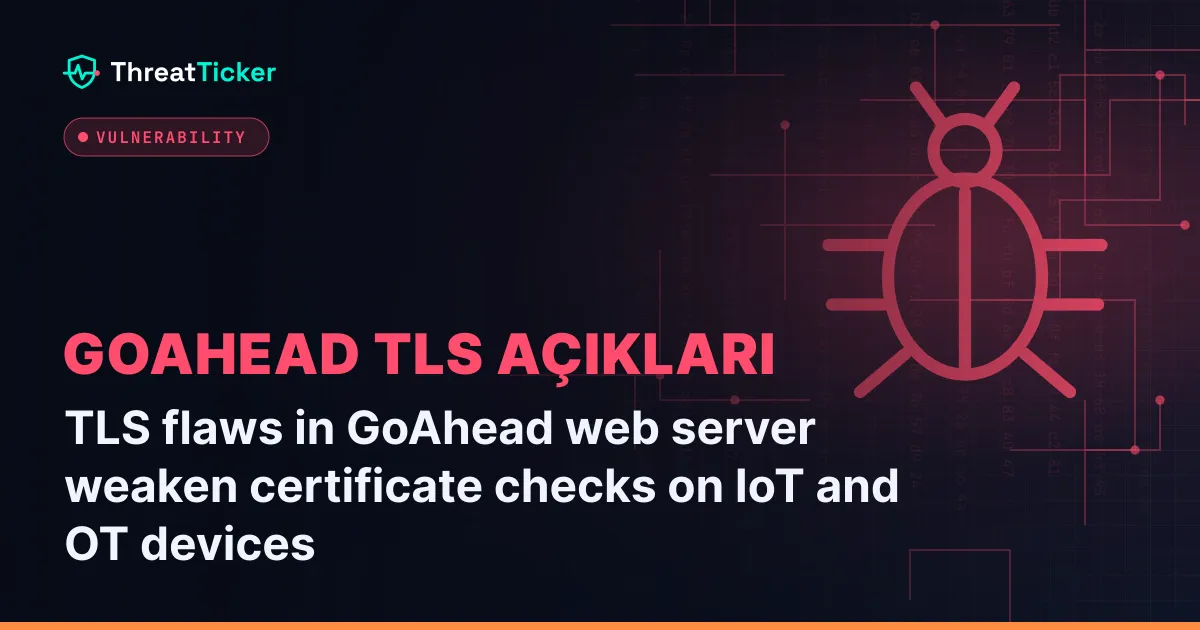
TLS flaws in GoAhead web server weaken certificate checks on IoT and OT devices
FoxIO disclosed three TLS weaknesses in the GoAhead embedded web server, including a critical flaw that lets revoked client certificates still be accepted.
At a glance
- The critical flaw CVE-2026-115881 (CVSS 9.1) makes GoAhead accept revoked client certificates in mutual-TLS setups because it never asks OpenSSL to check the revocation list.
- FoxIO says GoAhead runs on hundreds of millions of IoT, OT, firewall and military devices, though each flaw hits only certain TLS-library and certificate configurations.
- Upstream fixes shipped in GoAhead 6.1.1 on August 2, but FoxIO cautions that a patched library does not mean a device update exists yet.
- FoxIO published proof-of-concept code and fingerprints so defenders can find exposed GoAhead servers and identify their TLS backend.
Security firm FoxIO has disclosed three vulnerabilities in GoAhead, the lightweight web server from EmbedThis that is widely embedded in connected devices, that weaken the security of its TLS connections. According to SecurityWeek, which reported the findings on October 28, 2026, the most serious issue lets a server keep trusting client certificates that have already been revoked. FoxIO says GoAhead runs on hundreds of millions of devices across the IoT, operational technology, firewall and military sectors.
What happened
FoxIO researcher Sébastien Féry documented the three flaws in a blog post this week, and advisories for all of them were published on October 12, SecurityWeek reports. None of the defects stops the affected TLS handshake from completing, which is what makes them dangerous: a connection that should be rejected is instead allowed through. FoxIO's founder and chief technology officer, John Althouse, stressed that an upstream fix does not automatically mean device makers have shipped a patch, because that step is left to each manufacturer.
Technical details
The most severe flaw, tracked as CVE-2026-115881 with a CVSS score of 9.1, affects GoAhead 3.4.5 through 6.1.0 when built with OpenSSL or a compatible library and configured for mutual TLS with a certificate revocation list (CRL), according to the advisory. SecurityWeek reports that the server reads the CRL but never tells OpenSSL to enforce it, so revoked certificates — including those tied to lost or stolen devices — are still accepted, with no warning at startup.
A second issue, which has no CVE and is rated CVSS 5.9, affects GoAhead 4.0.2 through 6.1.0 builds that use Mbed TLS; FoxIO says a coding error weakens some TLS 1.2 connections so that recorded sessions could be decrypted offline, but only if the client accepts the flawed parameters. The third flaw, CVE-2026-115884 (CVSS 7.4), affects builds using certain LibreSSL versions and bypasses a certificate chain-length check, though only against servers that accept client certificates from any issuer.
Who is affected
FoxIO named vendors whose products use GoAhead, including Palo Alto Networks, Comcast, D-Link, HP, Siemens and Boeing, but said it has not confirmed whether their devices run a vulnerable configuration. Because each flaw depends on the specific TLS library and certificate-check setup, only a subset of deployments is exposed per issue, SecurityWeek notes. The article reports no known exploitation in the wild.
What to do
GoAhead 6.1.1, released on August 2, resolves the OpenSSL and Mbed TLS problems, according to SecurityWeek. For Mbed TLS builds, administrators can disable finite-field DHE cipher suites or move to the OpenSSL backend; for the LibreSSL issue, the recommendation is to enable issuer verification with a trusted certificate-authority bundle or switch to OpenSSL or LibreSSL 4.x. Device owners who cannot update directly should press their hardware vendor for a firmware fix, since GoAhead is typically delivered as part of a product's firmware. FoxIO has released fingerprints and proof-of-concept code to help defenders locate exposed servers.
Related CVEs
Sources
This story is based on the sources listed above. Always check the vendor’s official advisory before acting on critical systems.